Related project
Driving a Tesla Model 3 with a Nintendo Switch 2
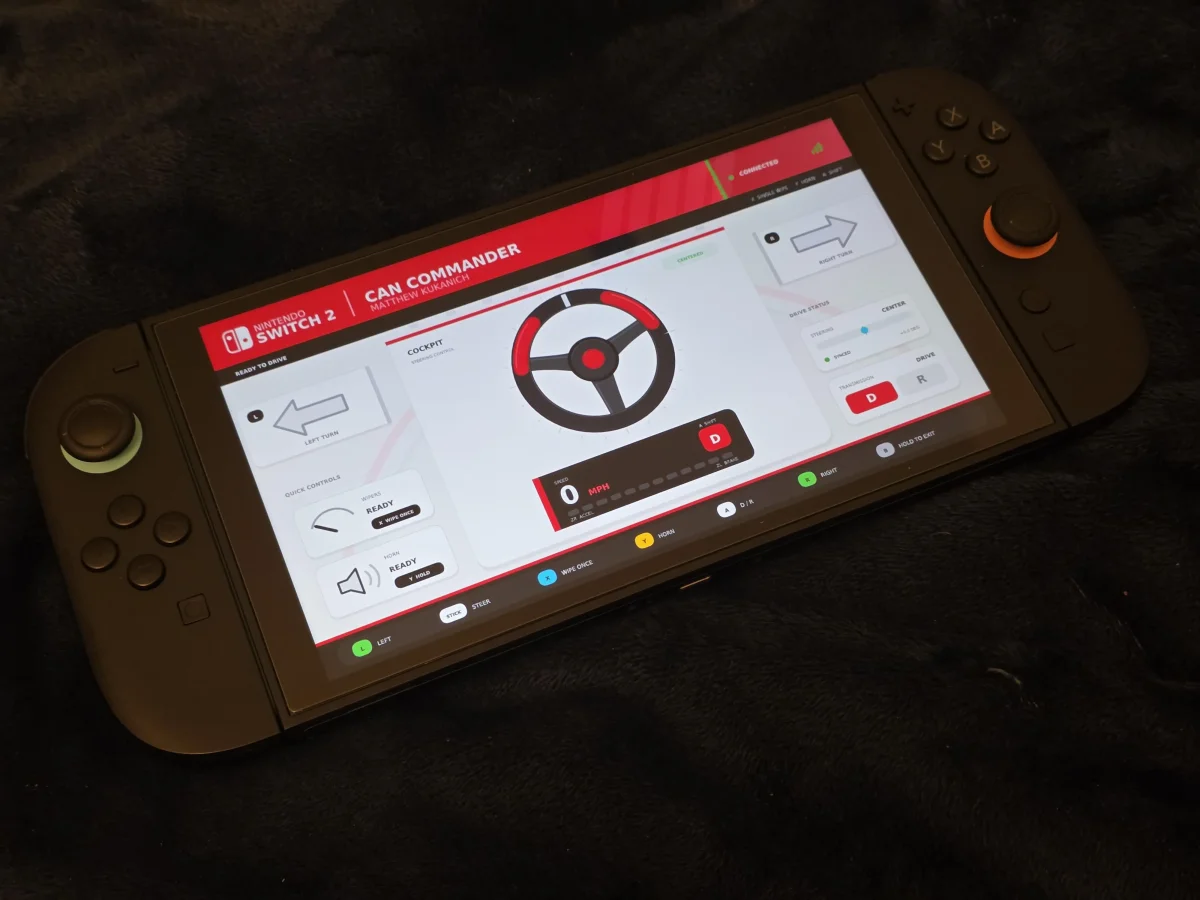
In November 2026, Matthew KuKanich published a video of a Nintendo Switch 2 controlling his 2024 Tesla Model 3. This page explains how the demo works and how it relates to CAN Commander.
What the video shows
A Nintendo Switch 2 running a custom application sends driving inputs to a 2024 Tesla Model 3. The application shows the CAN Commander name on screen, which is how many people found this site.
How it works
The console never talks to the car directly. It sends controller inputs to a separate microcontroller, and that microcontroller is what interfaces with the vehicle.
Nintendo Switch 2
Custom userland application that reads the controls.
Vehicle Control CAN Link
Separate, independently developed hardware that intercepts the autopilot computer's CAN signals and injects the inputs so they look authentic.
Tesla CAN networks
The vehicle's own internal networks.
The interesting part is the middle stage. The vehicle's control messages are not simply broadcast values that can be overwritten with a fixed frame. They carry rolling counters and checksums, and they sit alongside the real autopilot computer's own traffic, so a naive injected frame is either ignored or flagged as a fault.
The control microcontroller works around this by intercepting the autopilot computer's CAN signals. For each control it injects, it computes the correct checksum and counter values and keeps the inputs within the limits the vehicle expects, then places those frames onto the bus so that, from the vehicle's point of view, the controls appear to have come from the autopilot computer itself. The Switch only supplies the high-level intent; this stage is what turns that intent into messages the car accepts.
The demo does not use:
- Tesla Arcade,
- Tesla's built-in gamepad support, or
- any direct pairing between the console and the vehicle.
How it relates to CAN Commander
The Switch application carries the CAN Commander name on purpose. Both projects come from the same author and the same automotive CAN reverse-engineering work. They are not the same software.
| CAN Commander | Switch 2 Tesla demo | |
|---|---|---|
| What it is | A general CAN bus toolkit: ESP32 firmware, a Flipper Zero app and a command line | A standalone Switch application and a vehicle-specific control microcontroller |
| What it is for | Finding, decoding and sending CAN signals on vehicles in general | Demonstrating control of one specific vehicle |
| Where to get it | Open source on GitHub | Not part of the CAN Commander repository |
A CAN Commander board does not include the Tesla control shown in the video. Neither the firmware nor the Flipper app contains it, whether you buy the official board or build your own.
What CAN Commander does provide is the groundwork that this kind of research depends on: discovering which messages carry a function, decoding them, and testing changes safely. If that is what interests you, start with the features or the getting-started guide.
More controller demos
The Switch 2 is one of several controllers the author has used to drive the car this way. Each is a separate build on the same CAN research:
- Driving the Tesla with a Wii Remote (motion controls)
- Driving the Tesla with an Xbox controller
More demos and CAN reverse-engineering tutorials are on the author's YouTube channel.
For press and anyone sharing the video
Please credit the demo to Matthew KuKanich and link to this page or to cancommander.com. Two details that are often reported incorrectly:
- CAN Commander is the name of the author's open-source CAN bus toolkit. The Switch application is a related demo, not the toolkit itself.
- The demo does not rely on any Tesla gaming or controller feature.
Coverage so far includes Not a Tesla App, Tesla Owners Club of Austin, The Electric Viking, ONE Jailbreak and Logic-Sunrise, along with publications in German, Polish and Chinese.
Safety
This is a research demonstration by its author on his own vehicle. It is not a product, and controlling a vehicle this way is not something to attempt on public roads.
Driving at speed was tested only on a closed track, with authorization. Any such testing should be done the same way: on a closed course, with permission, and only on a vehicle you own or are authorized to work on.